So the weather finally turned a bit more traditional over the past few days with temps in the -10 below range and snow. We received about 3-4" of fresh powder last night and it put a nice clean coat over everything. The town is normally very brown from the volcanic soil and rocks around us so its a welcome change.
 |
| Looking out from my dorm across Winter Quarter's Bay to Scott's Hut. |
 |
| Fresh powder on Observation Hill |
 |
| A view across the harbor at Hut Point and Scott's Discovery Hut |
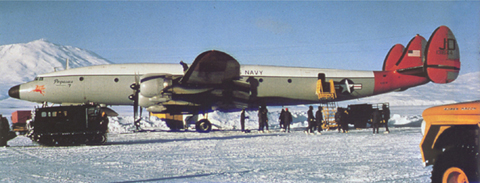
So it's Sunday here, the recreation department tries to offer up different trips and such around the area to see unique sights that most folks normally don't get to see. Today I signed up for a ride out on the ice shelf to an old plane wreck that happened in 1970. The aircraft is a C-121 Super Connie (Constellation) that was being flown by VXE-6, the US Navy squadron that supported Operation Deep Freeze up until the late 1990's.
 |
| Before.... |
The story goes like this, just
before 9am on October 8, 1970 the Super Constellation "Pegasus" (BuNo
131644) of VXE-6 departed from Christchurch Airport
on a ten and one half hour flight to Antarctica.
The Ill-fated Aircraft ended her life in a tangled heap on the ice of the Ross Sea. Appropriately named
"Pegasus"-the flying horse, this was her seventh year of Antarctic operations.
The mission was to open up
"Operation Deep Freeze 71", destination the ice runway Williams
Field, McMurdo Sound, and 2,600 miles away
over open frozen water. A routine squadron's flight but was to end in tragic
circumstance's ten and one half hours later. Half
an hour out from McMurdo, the weather had deteriorated to zero visibility with
an intense
storm, which had enveloped the base. Low on fuel and no alternative airfield, the aircraft commander was forced to "crash land" the aircraft. After making five approach attempts to minimums they broke out, landed and the right main landing gear was sheered off by an unseen 4' snow drift caused by the storm and winds. The aircraft veered
off to the right side of the ice runway
and the "Connie" was destroyed without loss
of life.
 |
| ...and after. |
The aircraft remained in the vicinity of Williams Field for the season, however for obvious morale reasons, seeing one of your squadron's wrecked aircraft daily with its wing ripped off in heap was not good for the troops. The commander decided at the time to haul the wreck out of plain sight about 10 miles away on the ice shelf where the current permanent ice runway is located, now named for its historic neighbor, Pegasus.
 |
| Snapshot view of the crash site and surrounding ice shelf |
So its now partially buried in drifting snow and ice about 2 miles from the current airfield location. We were the first tour of the season, typically by season end, it's dug out enough by curious folks that most of the aircraft is exposed. It's a neat opportunity to see and spend an afternoon. How many times can you say you crawled around a plane wreck on an ice shelf? Hopefully, this is my only time--a planned outing!
 |
| A look back at what's left of the empenage |
 |
| Crawling on top |
 |
| A look down the fuselage |
Kind of cool, right? It's always neat discovering new things to see around here. Back to my work week now. Weather permitting, I'm off to go fly tomorrow and then I can't wait for Tuesday--off to South Pole Station! That will be great.


